
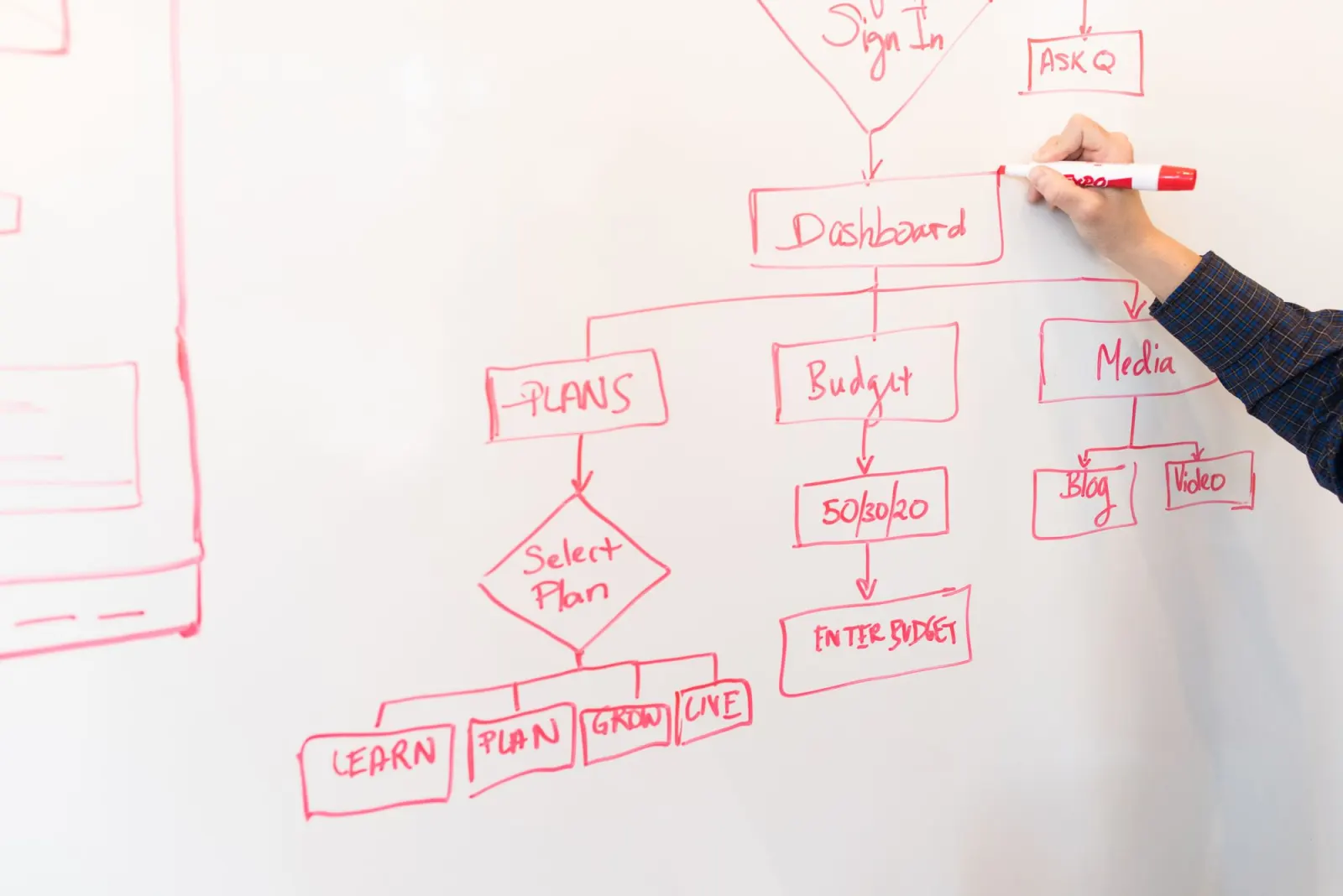
In most founder-led companies, the sales process exists. It just lives in one person's head.
Write it down as stages, each with exit criteria: what must be true, on the buyer's side, before a deal moves forward.
Give every stage an owner and one or two numbers. That's enough to find where deals die.
A process only works if the team uses it every week, and the founder plays by the same rules.
Your company has a sales process. It's just that nobody can see it but you.
You know which leads are worth a call. You know the question that tells you a buyer is serious. You know when to send the proposal and when to wait a week. You've never written any of it down, because you never had to.
Then you hire reps. They work hard. They fill the CRM. And somehow the deals still end up on your desk, because you're the only one who knows what "ready to close" looks like.
That's not a people problem. It's a missing process.
The short version
To build a sales process, map the stages your best deals already move through, then write down the exit criteria for each stage: what must be true, on the buyer's side, before the deal moves forward. Give each stage an owner and one or two numbers, and run the pipeline review against those rules every week.
The process in your head
Here's what most people won't tell you: founders don't lack a sales process. They lack a written one.
You sold the first few million by instinct. That instinct is real. It's pattern recognition built on hundreds of conversations. The trouble is that instinct doesn't transfer. A new rep can't borrow your gut.
So what happens? Every rep invents their own version. One calls a deal "qualified" after a friendly first meeting. Another won't use the word until the budget is approved. Your pipeline report adds those two numbers together and calls it a forecast.
And you keep getting pulled back in. Not because the team is weak, but because you're the only source of truth on what good looks like.
If the process only works when you're in the room, it isn't a process. It's you.
What a sales process actually is
A sales process is the agreed set of stages a deal moves through, from first contact to signed contract, and the rules for moving between them.
That's it. It isn't a script. It isn't a methodology you bought from a training company. It isn't your CRM, either. The CRM is where the process gets recorded. If you install a CRM before you agree on the process, you get a very expensive list of opinions.
A good one answers four questions for every deal, at any moment:
- Where is it? Which stage, using words everyone defines the same way.
- Why is it there? Which exit criteria it has met, and which it hasn't.
- Who owns it? One name, not "the team."
- What happens next? A dated next step the buyer agreed to.
If your team can answer those four for every open deal, you have a process. If they can't, you have activity.
B2B sales process steps, with exit criteria
Every business is a little different, but most B2B sales process steps land close to these six. The middle column is the one that matters. Notice that every exit criterion is something the buyer did or said, not something your rep did.
Stage and ownerMoves forward whenNumbers to watch
1TargetMarketing or SDR
The account fits your ideal customer, and there's a named person to reach.
WatchNew target accounts a week
2DiscoveryAccount executive
The buyer described a problem in their own words, and agreed to a second meeting.
WatchFirst meetings held, and % that go on
3QualifiedAccount executive
You know the budget range, who decides, how they decide and when.
WatchQualified rate and deal size
4ProposalAccount executive
The decision maker has seen the proposal and confirmed it solves the problem.
WatchProposal win rate
5CommitAccount executive
Verbal yes, paperwork is with their legal or purchasing, and the buyer named the close date.
WatchDays in stage
6Won and handed offAE, then onboarding
Signed, and the onboarding team has the notes from every conversation.
WatchDays from signature to kickoff
Six stages is plenty for most companies doing $2M to $50M. Fewer is fine. More usually means someone is tracking tasks, not stages.
The last stage surprises people. Most processes end at "closed won." I don't think they should. The deal isn't done until the customer is in good hands, because the revenue you keep counts as much as the revenue you win.
How to build a sales process, step by step
This is the order I work in. It's practical, and none of it needs new software.
1. Pull your last ten wins. Not the ones you remember best. The last ten. For each, write down how it started, who was involved and what happened between first call and signature. Patterns show up fast.
2. Pull your last ten losses. Same exercise. Where did they stall? Most companies find their deals die in one or two places, over and over.
3. Name the stages. Use the moments where the deal clearly changed shape. A first real meeting. A proposal. A verbal yes. Use plain words your whole team will say the same way.
4. Write the exit criteria. For each stage, finish this sentence: "A deal moves forward when the buyer has..." This is the hard part, and the most valuable. More on it below.
5. Assign owners. One role per stage. When a deal changes hands (marketing to sales, sales to onboarding), write down what gets passed along.
6. Pick the numbers. One or two per stage. Conversion to the next stage, and time spent in it. That's usually enough.
7. Put it in the CRM, then run it. Set your stages to match, and make the exit criteria required fields where you can. Then run every pipeline review against the rules. The first month will feel slow. That's the process doing its job.
Exit criteria: the part everyone skips
Most sales processes have stages. Very few have exit criteria. That's why most pipelines lie.
Without exit criteria, stages measure how hopeful a rep feels. A deal sits in "proposal" because the rep sent a proposal. Did the decision maker read it? Did anyone confirm it fits? Nobody knows.
Good exit criteria share three traits:
- They're about the buyer. "Sent the proposal" is an activity. "The CFO confirmed the proposal fits their budget" is a criterion.
- They're yes or no. Either it happened or it didn't. No "mostly."
- They're checkable. A manager can ask "how do you know?" and get a real answer.
The qualified stage deserves extra care, because it's where bad deals sneak in and eat your team's time. I wrote a full guide on how to qualify leads so your team stops chasing the wrong deals.
The few numbers that matter
You don't need a dashboard with forty charts. You need a few numbers you look at every week, the same way, with the same people.
Start with these:
- Stage conversion. What share of deals move from each stage to the next.
- Time in stage. How long deals sit before they move or die.
- Win rate. Of the deals that reach a proposal, how many close.
- Average deal size. Tracked over time, not just this quarter.
Here's why these four matter. Say your team holds 40 first meetings a month, half become qualified, and a quarter of qualified deals close at $30K each. That's five deals and $150K a month. Now you can see exactly which lever moves revenue. Lift the qualified rate, and the whole chain grows behind it. Without the stages, all you'd know is "we closed $150K."
That example is made up, but the math works the same in every business. Once you see it, you stop asking for "more leads" by default.
Free Executive Revenue Review
Not sure which stage your deals are dying in? Let's find out.
Answer 20 quick questions. My team and I study your business, then I send you a private review. Free, and personal.
Get your free revenue review About 4 minutesPrivate review in 2 business days
Where B2B sales processes break
A B2B sales process rarely breaks in sales alone. Sales is all or nothing. Strategy, team, tools, operations and marketing all feed the same pipeline, and one weak part drags down the rest. These are the breaks I see most:
- The handoff from marketing. Leads arrive with no context, and reps start from zero.
- The middle of the deal. Buyers go quiet after the second meeting, usually because an objection never got said out loud. Here's how to handle sales objections B2B buyers raise most.
- The founder exception. Your deals skip the rules. So the team learns the rules are optional.
- The CRM that nobody trusts. Stages in the software don't match the stages in real life.
- The handoff to onboarding. Promises made in the sale get lost on the way to delivery.
Each of these is a leak. Money you already earned the chance to win, slipping out between stages. If you want to see where it's happening in your business, start with my guide to revenue leakage.
How to make your sales process stick
Writing the process takes a week. Living by it takes a quarter.
Three things make the difference.
Run the weekly review against the rules. Every deal, every stage: "What's the exit criterion, and how do we know it's met?" Deals that can't answer move back. It feels harsh the first few weeks. Then it becomes normal.
Follow your own process. This is the hard one for founders. If your deals skip stages, so will everyone's. Put your deals in the same pipeline, under the same rules.
Change it on purpose. Review the stages every quarter. If a criterion never predicts anything, cut it. If deals keep dying in the same spot, add a step there. A process is a living document, not a poster.
I learned this early. I was the first employee and head of sales at a tech company that grew to $8M a year and 70+ people before it was acquired by a division of Mellon Bank. Since then I've led teams of 80+. The companies that scaled weren't the ones with the cleverest process. They were the ones that used theirs every single week.
If you'd rather not build this alone, it's a big part of my sales and GTM consulting work. My team and I map the process with you, set up the CRM to match and run the first reviews until they run without us.
Want to know where your process leaks today? Start with the free revenue review.

Written by Joe Greco
Fractional CRO with 25+ years building B2B revenue. I lead revenue for a small number of companies at a time, with a network of 40+ specialists behind me.
More about me